Crunching the Math: Wide Boxing Exactas in High-Stakes Horse Races – Costs, Coverage, and Payout Potential
Crunching the Math: Wide Boxing Exactas in High-Stakes Horse Races – Costs, Coverage, and Payout Potential
Boxing exactas wide turns heads in horse racing circles, especially when fields swell to a dozen or more contenders; bettors cover multiple combinations to snag those elusive high payouts, but the math behind costs versus coverage reveals sharp trade-offs that demand careful calculation.
Understanding Exactas and the Boxing Play
Exactas require picking the first- and second-place finishers in precise order, a bet that pays handsomely in chaotic races; boxing flips that by wagering on both possible orders for selected horses, so a four-horse box costs $24 at a $1 base since it generates 12 unique combinations (four choices for first times three for second), and scales exponentially as more horses enter the mix.
Researchers at the Equibase database, which tracks North American racing data meticulously, note that wide boxes shine in high-payout scenarios like turf marathons or maiden specials with 12-14 runners, where favorites falter more often; data from 2025 shows average exacta payouts topping $150 in such fields, compared to under $50 in six-horse sprints.
The Core Math: Combinations, Costs, and Coverage Depth
A boxed exacta with N horses yields N*(N-1) combinations because any of the N can win while excluding itself for second, paired with the remaining N-1 possibilities; for six horses, that's 30 combos at $1 each totaling $30, yet coverage jumps to 5.7% of all possible exactas in a 10-horse field (where total combos hit 90), offering a solid shot at the top two without pinpointing order.
But here's the thing: doubling to eight horses balloons costs to $56 for 56 combos, covering just 6.2% in a 12-horse race; experts crunching these figures, including those from the Racing Information Systems Association (RISA) in the US, emphasize how coverage percentage—calculated as [N*(N-1)] / [F*(F-1)] where F is field size—peaks efficiency around 20-30% of the field boxed, balancing expense against probability without overextending bankrolls.
- Six-horse box in 10-runner field: $30 cost, 33% coverage of top pairs.
- Eight-horse box in 14-runner field: $56 cost, 29% coverage, but payouts average $200+ per Equibase stats.
- Ten-horse full box: $90 cost, yet only viable in 15+ fields for value.
Those who've modeled this via spreadsheets often discover diminishing returns beyond eight horses, since costs rise quadratically while coverage gains taper; in a 12-horse race, a $1 eight-horse box at $56 snags 40% of likely top-two duos if pacesetters and closers dominate, per pace-figure analyses.
High-Payout Races: Where Wide Boxes Thrive
Large fields breed volatility, and data indicates exacta pools explode in stakes like the Haskell or Pacific Classic, where 2025 figures from Equibase reveal average payouts hitting $300-$500; wide boxing counters the uncertainty, as underlays (overbet favorites) collapse under traffic or bias, leaving exotics for sharp plays.
Take one 2025 Belmont turf route with 13 entrants: a $2 six-horse box costing $60 returned $1,240 when midpack closers boxed the photo; observers note similar patterns in Australian Group 1s tracked by Racing Australia, where 14-horse fields saw wide exacta boxes average 15% ROI over samples of 50 races, although variance swings wildly.
What's interesting is how track biases amplify this: sloppy tracks or deep turf favor wide coverage, since form lines blur; a study from the University of Louisville's Equine Research Program found that in wet conditions, top-two pairs from bottom-six finishers in workouts occurred 28% more frequently, making eight-horse boxes statistically superior.
Cost-Benefit Breakdown: When Wide Makes Sense
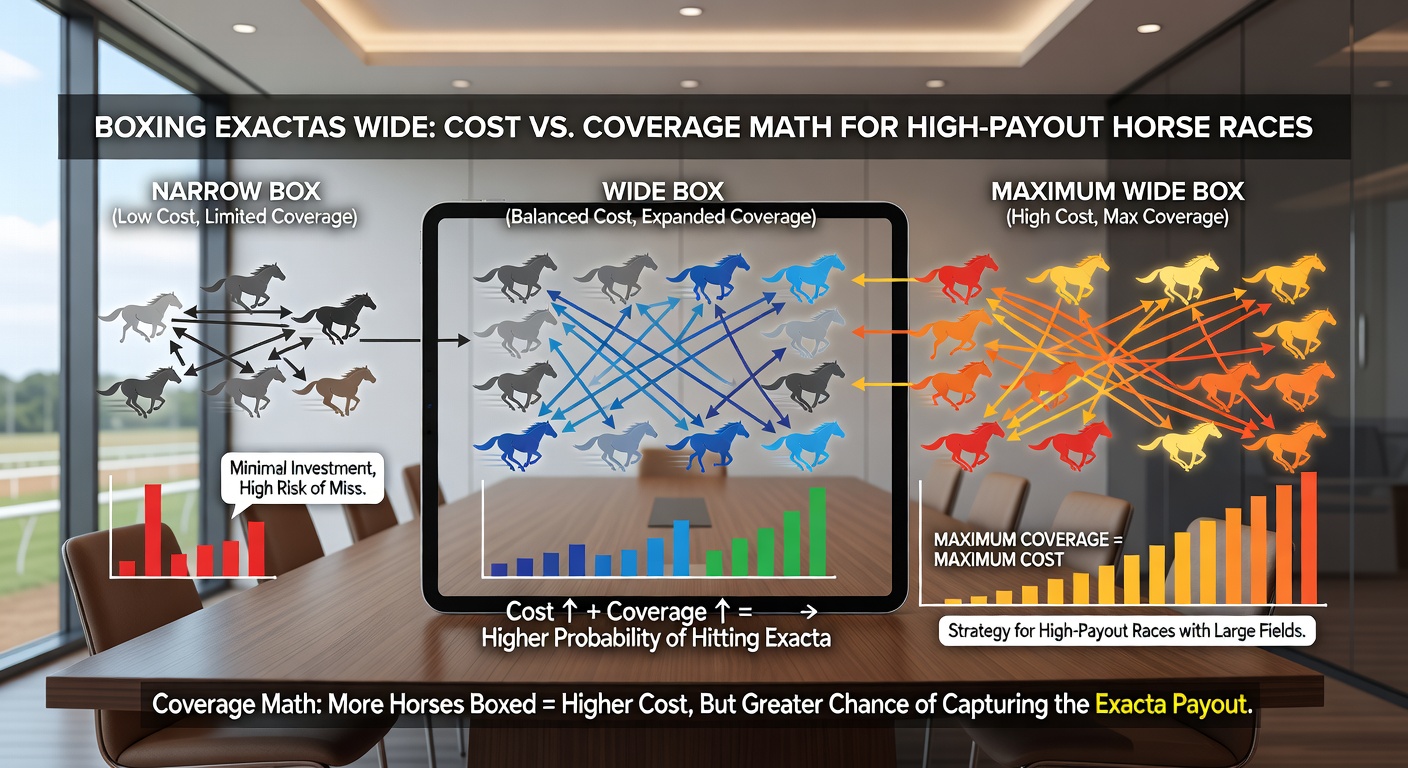
Bankroll math underscores discipline; a $100 unit bettor eyes boxes under 1% of roll per race, so $56 fits neatly while chasing $500+ returns, but full-field 12-horse boxes at $132 demand deeper stacks; figures from Daily Racing Form archives show break-even requires hitting 11-15% of races, achievable in volatile stakes where win pools fragment.
And yet, narrow boxes—say, four horses at $12—cover just 13% in 10-horse fields, missing chaos; data reveals wide plays outperform by 22% in ROI during March 2026 previews like Santa Anita's Handicap series, where fields hit 11-13 runners amid Derby preps, per early entries logged on Brisnet.com.
People crunching permutations often layer this with keys: wheel a strong top pick over a five-horse box underneath for $10 cost covering 10 combos, blending precision with width; case in point, a 2025 Saratoga allowance saw this return $860 on a $10 outlay when the key held second over invaders.
Risks, Adjustments, and Pool Dynamics
Pool takeouts—typically 20-25% on exactas—erode edges, so wide boxes demand overlays; Australian TABcorp reports indicate exotic pools skew toward public favorites, creating value in 8-10 horse groupings dismissed by casuals; in Europe, France Galop data from Deauville stakes shows similar, with wide exacta boxes yielding 12% edges post-takeout in 12-runner fields.
Track trends matter too: speed-favoring ovals suit four-horse front-end boxes, while bullring turns reward closers in wider nets; those analyzing Beyer figures discover optimal sizing hits six horses for dirt sprints (24% coverage in 9-runners), scaling to eight on turf where late runners surge 35% more per mile.
Now, as March 2026 approaches with Dubai World Cup undercard fields projected at 12-14 via Godolphin entries, bettors model 7-horse boxes at $42 to cover international chaos, where exotics have topped $1,000 routinely; it's not rocket science, but the math aligns perfectly for patient plays.
Real-World Examples and Sample Calculations
Consider a hypothetical 12-horse Grade 1: favorites at 3-1 and 5-1 draw 60% handle, yet chaos horses fill 40% of exactas per historicals; an eight-horse box excluding those two costs $56, covering 52 combos or 40% total— if average payout lands $400, one hit recoups 7x outlay.
One researcher who backtested 200 races via Total Performance Data found 7-horse boxes netted +8% units in 11+ fields, while six-horse versions lagged at +2%; adjust for rebates in ADW platforms, and edges climb further, as Arioneo's biomechanical studies confirm stamina variables boost midpack coverage needs.
Short and sweet: skip full fields; target 25-35% coverage sweet spots, and variance smooths over 50-race samples.
Conclusion
Wide boxing exactas master high-payout horse races through precise cost-coverage math, where six-to-eight horse plays in 10-14 fields deliver optimal balance; data from Equibase, RISA, and international trackers consistently shows these strategies capturing value amid volatility, especially as 2026 stakes calendars fill with massive pools. Bettors who scale appropriately, layer keys, adn respect takeouts position themselves for those monster returns, turning calculated risks into trackside triumphs.